
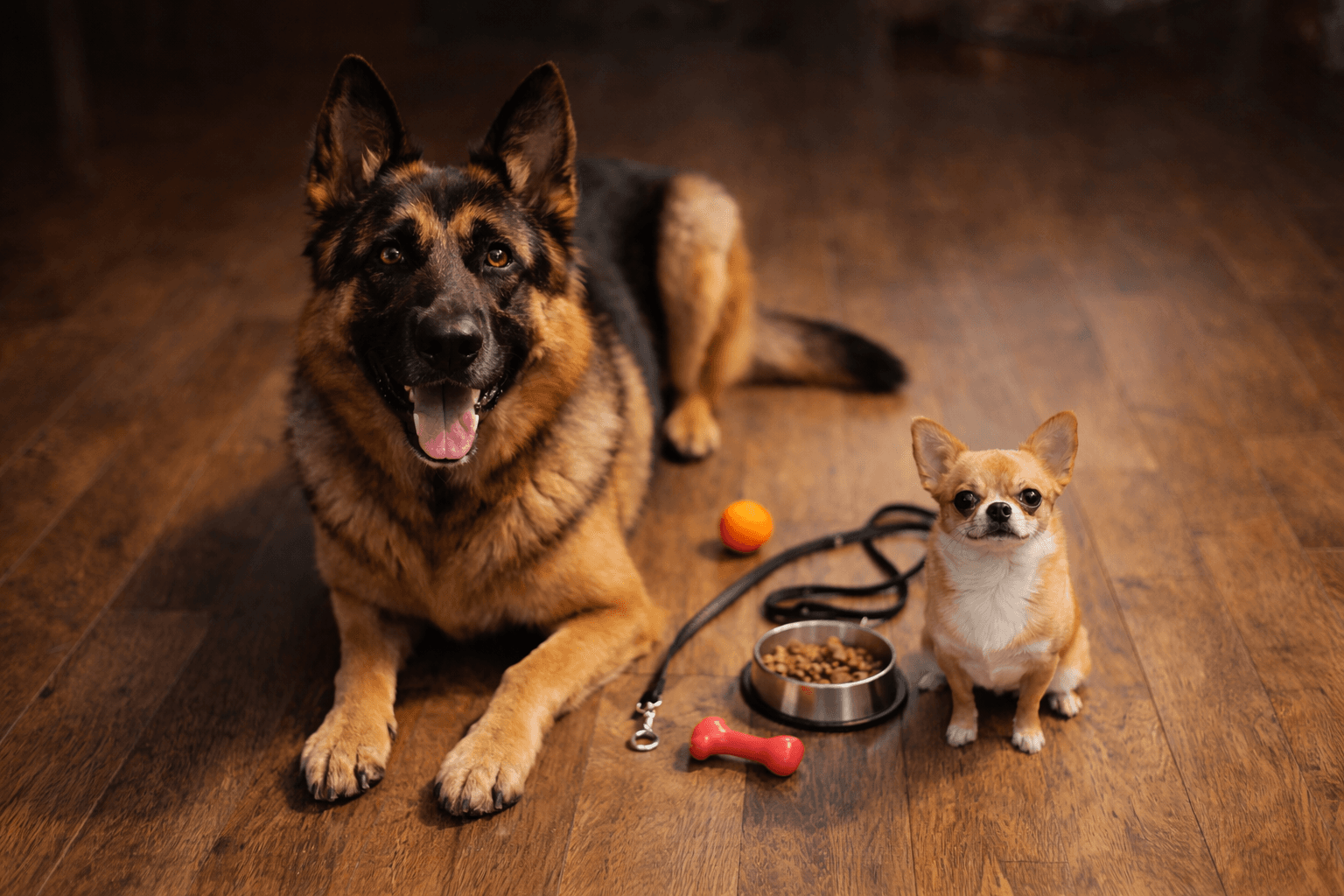
The relationship between size and behavior
It is important to state: there is no “better” or “worse” category.
There are appropriate and inappropriate pairings.
Large breed dogs: strength, stability, need for structure
Large breeds – such as the German Shepherd, Labrador Retriever, Rottweiler, or Bernese Mountain Dog – often have a stronger protective instinct, greater physical presence, and more pronounced dominance or territorial sensitivity.
- This is not aggression.
- This is potential.
With large breed dogs, the consequences of training deficiencies can be more visible and more risky. A 5-kilogram dog pulling on the leash – unpleasant. A 45-kilogram dog – loss of control.
At the same time, many large-breed dogs are surprisingly balanced, calm, and dignified in adulthood. Their exercise needs are higher, but mentally they are often more stable if they live within appropriate boundaries.
The key: consistency, physical and mental exhaustion, structured life.
Small dogs: mobility, responsiveness, emotional closeness
Small breeds – chihuahua, yorkshire terrier, dachshund, pomeranian – often have livelier responsiveness, quicker arousal levels, and more intense attachment patterns.
A common phenomenon is behavioral problems due to overprotection: the owner is more permissive because the dog is "small." Rules become loosened. The consequence: excessive barking, separation anxiety, nervousness.
Size does not reduce the need for training. On the contrary. Small dogs often require greater awareness because physical limitations set fewer boundaries for behavioral faults.
Apartment or garden? The danger of oversimplification
A common misconception is that:
Big dog = garden
Small dog = apartment
The reality is more complex. A bored, understimulated large dog causes damage in the garden. A properly exercised large dog rests inside an apartment. A small dog can also be destructive indoors if it is not mentally exhausted.
- Space is not the solution.
- Structure is.
Owner attitude: the decisive factor
The size of the dog often reflects the personality of the owner as well.
Those who choose a large dog often strive for control, presence, decisiveness. Those who choose a small dog often seek mobility, adaptability, and closer physical proximity.
- Neither is better.
The question is: is the decision conscious?
Is there time for 1–2 hours of active engagement daily?
Is there consistency in enforcing the rules?
Is there physical capacity to control the animal?
Is there patience for teaching?
Who suits whom?
A large dog can be ideal for:
An active lifestyle
For a sporty owner
For a family with a structured daily routine
For a person who is not afraid to take responsibility
A small dog can be ideal for:
Urban environments
Frequent traveling
Older owners
First-time dog owners (with a conscious attitude)
But in the end, it's not the size that matters. It's the compatibility.
The Most Important Question
It’s not about being big or small. It's about whether you are prepared to be a consistent owner.
- A dog is not a status symbol.
- Not decoration.
- Not a project.
But a daily responsibility – regardless of size.
