As you all surely know, the March Crufts BIS winner is a beautiful Flat Coated Retriever, Baxer, from Norway.
On this occasion, we spoke with one of the breed's domestic breeders and experts, Regina Illés, owner of the Daliás Hunters kennel, and Péter Koleszár, an enthusiastic fan of the breed and owner of 2 beautiful Flats.
How many years have you been breeding the breed and how large is your Flat population now?
Regina:
I have been working with retrievers for 12 years and with Flat Coated Retrievers for 10 years; currently I have 6 Flat Coateds and 1 Golden Retriever.
I have been breeding the breed for 7 years, and I was the first to officially start breeding the breed in Hungary; prior to this, as far as I know, only 1 litter was born in the country about 11-12 years ago.
Péter:
I am a relatively new member of the Flat community, I have only been a Flat owner for 2 years. I own an active, hunting-involved male and a young female.
As a Flat breeder, how did you experience Baxer's success?
Regina:
I watched the live broadcast, including winning the Best of Breed title, as Baxer was already quite well known to me since our Amy is a Baxer puppy.
Also, Piper, who is currently 6 months old, is from Amy’s first litter and is Baxer's first brown grandpuppy bred in Hungary.
It is a huge honor that this wonderful dog can be one of the cornerstones of my kennel.
The whole Flat Coated community was rooting for Baxer as one at Best in Show, I was almost jumping out of my skin, and I admit I shed a few happy tears.
Péter:
I was more nervous than when showing my own dogs at exhibitions. Social media almost exploded, all my Flat acquaintances were shouting the success from the rooftops.
To whom/what kind of prospective owner would you recommend the breed?
How would you describe the breed’s characteristics/features? What kind of dog is it really?
Regina:
I recommend this breed exclusively to active families who like to spend their time hiking or doing retriever work. The Flat Coated Retriever’s attachment to people and its “will to please” attitude truly reflect the breed’s character. However, independent thinking and acting are also present in a high proportion in the breed.
It’s not typically a breed for first-time dog owners; it doesn’t hurt if you have previous experience with retrievers. I recommend it to those who like thoughtful dogs and don’t shy away from longer, more time-consuming training.
With this breed, the private sphere completely disappears from our lives, in a good way; they always want to be with their owner and can help in every activity.
Regarding retriever work, you get a fast, lively breed, but because of its high intelligence, it often tends to approach problem-solving in a peculiar way, which doesn’t always align with the owner’s expectation. Nevertheless, training it is very enjoyable, as the breed also has the characteristic humor of retrievers.
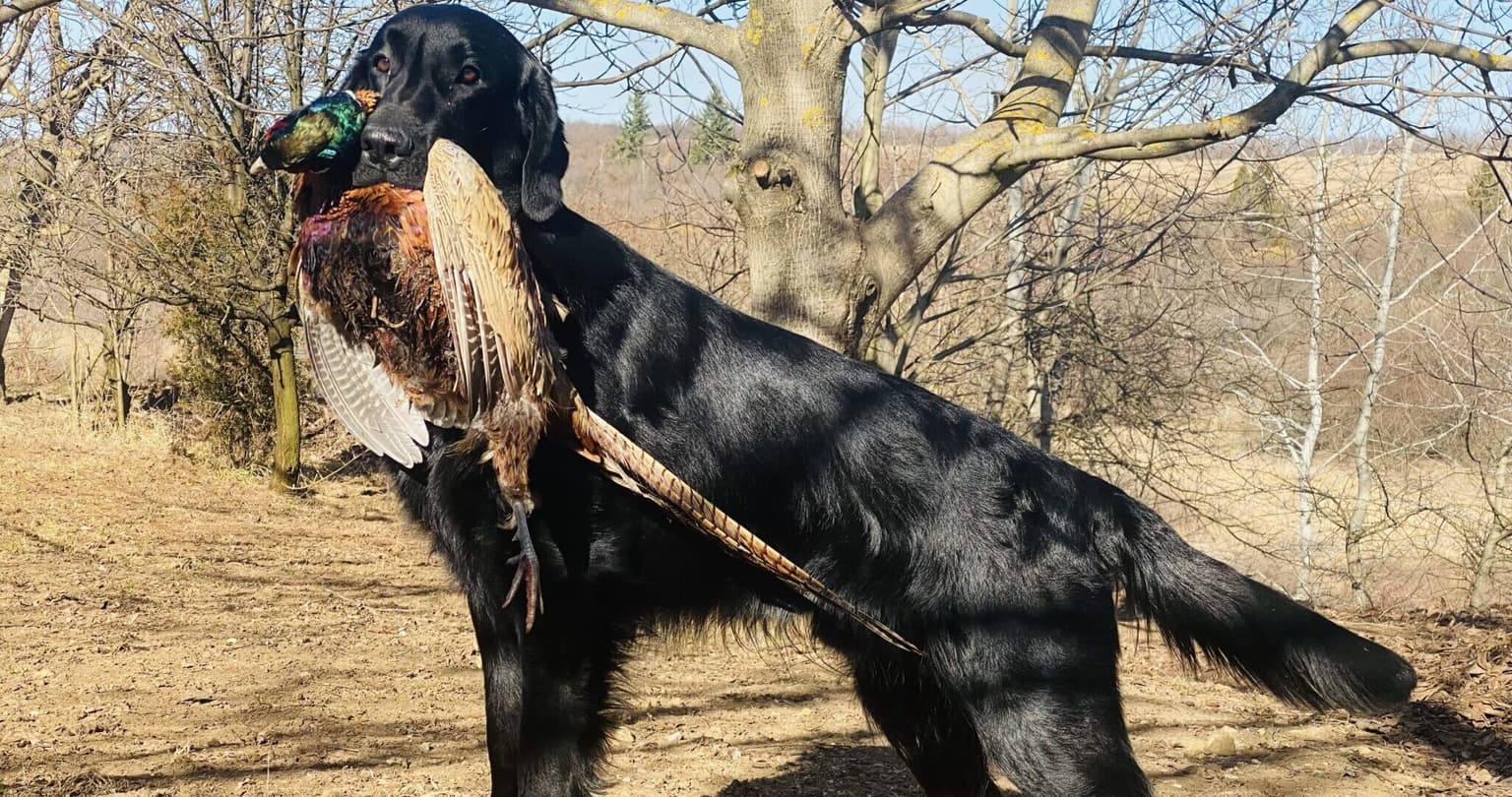
Wherever we hunted, my dogs always left a deep impression with their speed, agility, situational awareness, precise marking, and completing complicated directional retrieves.
Péter:
Being a Flat owner is a challenge. It requires a lot of attention and means a lot of exercise and activities. It is especially true with this breed that you need to be able to tire it out not only physically but also mentally. It fits very well with other dogs, even a male with another male. It is ideal as a family dog, but families with young children need parents who can ensure the dog is sufficiently exercised; “little play” with the kids is not enough. Those worried about their garden being dug up by a digging dog have less reason to worry than with many other breeds.
It is a particularly ideal breed for hunters who go after small game. Although retriever work is not about searching and pointing, the Flat still acquires these abilities. And when it comes to retrieving shot game, it delivers outstanding performance.
What keeping or other conditions would you hesitate to recommend it for?
Regina:
As I mentioned before, the Flat Coated Retriever is a very contact-seeking dog, so it always wants to be where we are, and that is just as it should be, which is why people know us inside and out. However, most owners are working people, so typically indoor-outdoor living applies, as with most retrievers. For exclusively outdoor keeping, for example, I do not give puppies, since they are family members. It also feels excellent in a pack, and it likes the company of other dogs or any other animal species.
Péter:
Keeping a Flat without the possibility to swim or bathe is not advisable. Their attachment to water also inspires even those breeds that were bred for less aquatic work to enjoy swimming and water retrieving. Transporting and caring for a wet dog requires humility, patience, and determination. This should be considered when choosing the breed.
Many people call the breed a black Irish Setter, long-haired Labrador, or even a dark Golden Retriever. Is there any truth to this?
Regina:
Many books and articles have already been published about the origin and early breeding of the Flat; I would rather leave their analysis to you.
Setters certainly played a role in the breeding of the breed, as we still see traits today in their work, temperament, and appearance that are characteristic of setters.
It is rumored that the first "yellow" Flat, that is, a yellow Flat was what made the breeding of the Golden Retriever possible.
Péter:
Since our other dog is exactly an Irish Setter, we hear the comment "oh, two Irish Setters, one is black..." endlessly.
Very few people know the breed. In the breed recognition competition of the country's 20 best gamekeepers, only a few were able to classify it among the retrievers.
Is the situation similar to several other retrievers with this breed as well? Is there a working line and a show line?
Regina:
Not specifically, in fact... while the working and show lines are completely separated in the Golden and Labrador Retrievers, this is not characteristic at all for the Flat coated retriever, because the dogs' inherited abilities are still much stronger, and it is neither necessary nor desirable to breed solely for work at the expense of appearance.
Péter:
The separation of the two lines is not typical within the breed, but breeders and owners who consciously involve their flat in some kind of work (whether field trial, hunting, agility, or search and rescue work) try to highlight the dog's practice in this direction. One thing is certain, if someone wants to work with a Flat, they are less likely to go wrong than is often the case with other popular breeds.
It is often read in several places that liver is a rare color variant in the breed. Is there any significant difference between black and "brown" in temperament or participation in work?
Does any other color variant even exist?
Regina:
Since black is the dominant color in the breed's genetics, obviously most individuals are black. Actually, the brown "liver" variant is not that rare, it's just very difficult to breed truly beautiful "liver" dogs. Naturally, brown and yellow Flats have the same work ability and temperament as their black-colored counterparts.
The Flat coated, like the Labrador, comes in 3 colors: black, brown, yellow. For example, our black dog can also carry the brown or yellow color, or even both colors.
Currently, the FCI does not accept the yellow color, and this is unlikely to change until the breed-keeping country requests a modification.
So presently, black and brown colors are accepted; however, yellow Flat coated retrievers can also be born but unfortunately are registered as color faults and, of course, cannot participate in breeding.
Péter:
Unfortunately, I haven't had a brown Flat yet, but judging by other dogs' temperament, I have not noticed any significant difference. The "yellow flat believers" are also a very small group within the community. Many of them purposefully breed this color.
Subjectively, but for me, the contrasting eye to the distinctive typical Flat head shape is not attractive.
In Hungary, the breed is underrepresented, while in Northern Europe and Austria it is common to encounter families walking Flat-coated retrievers. What are the reasons behind this in the Hungarian domestic population?
Regina:
When I bought my first Flat 10 years ago, the ratios were much worse, and practically most of the first litter from 7 years ago went to family acquaintances.
The situation has changed over the past years, thanks to the puppies born and of course due to the participation in events (shows and work) the breed has become more well-known. However, perhaps most people get to know the breed abroad. Also, a narrow group consciously choose a dog breed and based on the information read on the internet, they decide to pick this breed.
The Flat has an incredibly large population in Scandinavian countries, for example, thanks to the population rescued during WWII.
In Sweden, we find the most famous kennels, such as Baxer breeders, who, after 40 years of breeding, were able to celebrate the Crufts victory following numerous world champion titles.
The Almanza kennel justifiably represents tremendous breeding value in the global Flat-coated retriever population; I myself am the owner of two Almanza dogs.
Péter:
For the rise in popularity of a breed, it is sometimes enough that a celebrity or public figure owns that breed. Their followers and fans give a sudden popularity boost to the breed, thereby initiating healthy population growth. For us – so far – there is no such person to catalyze such growth.
Browsing the participation statistics of shows – unlike many other breeds – the number of Flats is increasing year by year in Hungary. Does this growth also mean a quality improvement?
Regina:
Show statistics can be quite misleading in this regard, as most participants are breeders from neighboring countries who arrive with multiple dogs aiming to acquire Champion titles.
The active Hungarian population participating in Hungarian shows is currently about 6-8 dogs.
Péter:
The situation is indeed improving in terms of numbers. There are a few groomers who can prepare the Flats in very good quality, a skill that is quite breed-specific. Fortunately, judges are also increasingly familiar with the breed.
Is any change expected in Hungary or worldwide as a result of the recent Crufts success?
Regina:
Following the 2011 Flat Crufts victory, according to international breeders, there was a leap in interest in the breed internationally, demand may increase on an international level, but I don’t think it would significantly influence the breed’s recognition in Hungary.
Péter:
I really hope there won’t be such a surge that would attract the attention of puppy mills towards the breed. But increased interest leads to more litters, which means greater opportunity for conscious, responsible breeding.
How can one get a Flat puppy in Hungary today?
Regina:
Basically, the waiting list is not particularly long, but since it is still a barely known breed in Hungary, demand is not very high, so usually a Flat-coated retriever purchase needs to be planned a year in advance.
However, since my dogs are family members, it depends on the individual and character which dog is ready to have a litter. Furthermore, they are primarily working dogs, living for retriever work, so we try to dedicate most of the time to this area. Additionally, in recent years there has been a generational change in my kennel, as my founding dogs are now all veterans enjoying their well-deserved retirement years.
Péter:
The most important thing is for the future owner to understand what they are committing to with the breed. If the decision is made and there is no available puppy in the few domestic kennels at the moment, it is worth looking in neighboring countries. The population is particularly good in the Czech Republic, Slovakia, and Austria. However, anyone looking for a paperless, low-cost dog should not consider this breed. As with any other breed, the fundamental rule is to try to meet several individuals personally before deciding.
Returning to the Crufts success. Baxer – the winning dog – is his breeding line present in the Hungarian population?
Regina:
Baxer’s breeding line, through our Amy, is present in Hungarian breeding, and we hope that our kennel's youngest member, Piper, who is Baxer's brown granddaughter, will also experience similar successes.
Currently, of course, Baxer is the most successful dog in the world, but as I have already mentioned, Baxer had already won Best in Show titles at very prestigious shows before Crufts.
Thanks to COVID, there haven't been many shows or work competitions in recent years, so the World Show and European Show had mainly entries from surrounding countries, and the largest Flat breeders from Scandinavian countries could hardly participate.
From the years before COVID, there are naturally quite a few outstanding international results. (E.g.: Three-time world champion Flat Coated Retriever “Almanza End of Discussion” or Crufts 2015 Reserve BIS winner Flat “Castlerock Simply Magic”)
Péter:
Already the day after the Crufts success, several people at the dog school asked if this was the breed that won yesterday? The breed is expected to come into focus again. Perhaps the waves of this attention will also reach Hungary.
At Crufts, among the seven finalists, there was also a Hungarian-owned and bred dog. Do you see a chance that a Hungarian bred Flat will achieve similar significant international successes in the future?
Regina:
I think this is every breeder’s dream, but the road to this is very tough and long, and one must excel in every aspect, but nothing is impossible.
Péter:
Baxer was prepared for this success from birth; his nutrition, movement, everything was focused on this by the breeders. Baxer has covered a lot of bitches in recent years. In Hungary, there may be 6-8 dogs descending from his line, but there are also many descendants of Baxer's ancestors in Hungary.
There are some very promising Hungarian Flats; a few international successes would put our country on the Flat coating map. I root for the domestic breeders to succeed, whether in show or working lines.